Évora reveals its history at walking pace. Roman columns rise above the old town, while whitewashed lanes lead between squares and medieval stonework. Within the walls, the pleasure is in these changes of scale: an open square, a narrow street, the enclosed quiet of a cloister.
For a first visit, let the monuments give shape to the day without filling it. The historic centre is a UNESCO World Heritage Site, but it is also a place for coffee, lunch and wandering. Begin with the temple and cathedral, then leave room for the streets between them. Évora rewards attention as much as a carefully drawn route.
Finding your bearings within the walls
Évora sits at the heart of Alentejo Central. Its walled historic centre offers a natural starting point for understanding the region, with Roman remains, medieval buildings and whitewashed houses sharing the same streets. Explore on foot rather than treating each monument as a separate stop. The lanes and squares are part of the visit, not simply the space between sights.
Use the Roman temple and nearby cathedral as landmarks, then allow your route to loosen. Praça do Giraldo is another useful point of reference in the old town. Move between the open squares and narrower streets, noticing how stone doorways and white walls change the texture of the walk. There is no need to make every turn purposeful.
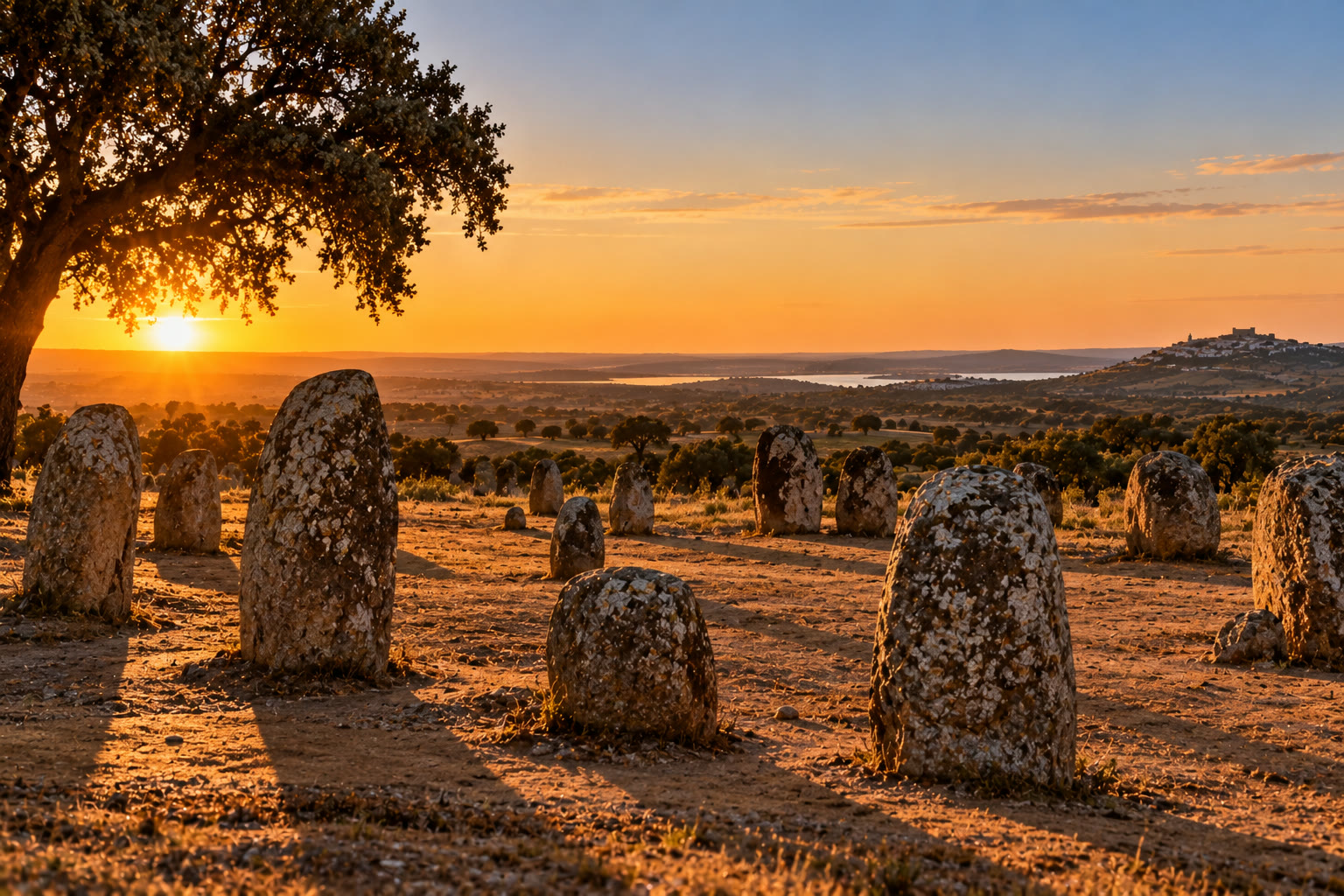
Keep the distinction between city and countryside clear. The cork oak forests, wine estates and megalithic monuments around Évora belong to a separate outing beyond the walls. For now, stay with the compact urban landscape. Leave space for a courtyard pause rather than trying to fold the surrounding region into the same walk.
The Roman temple and medieval cathedral
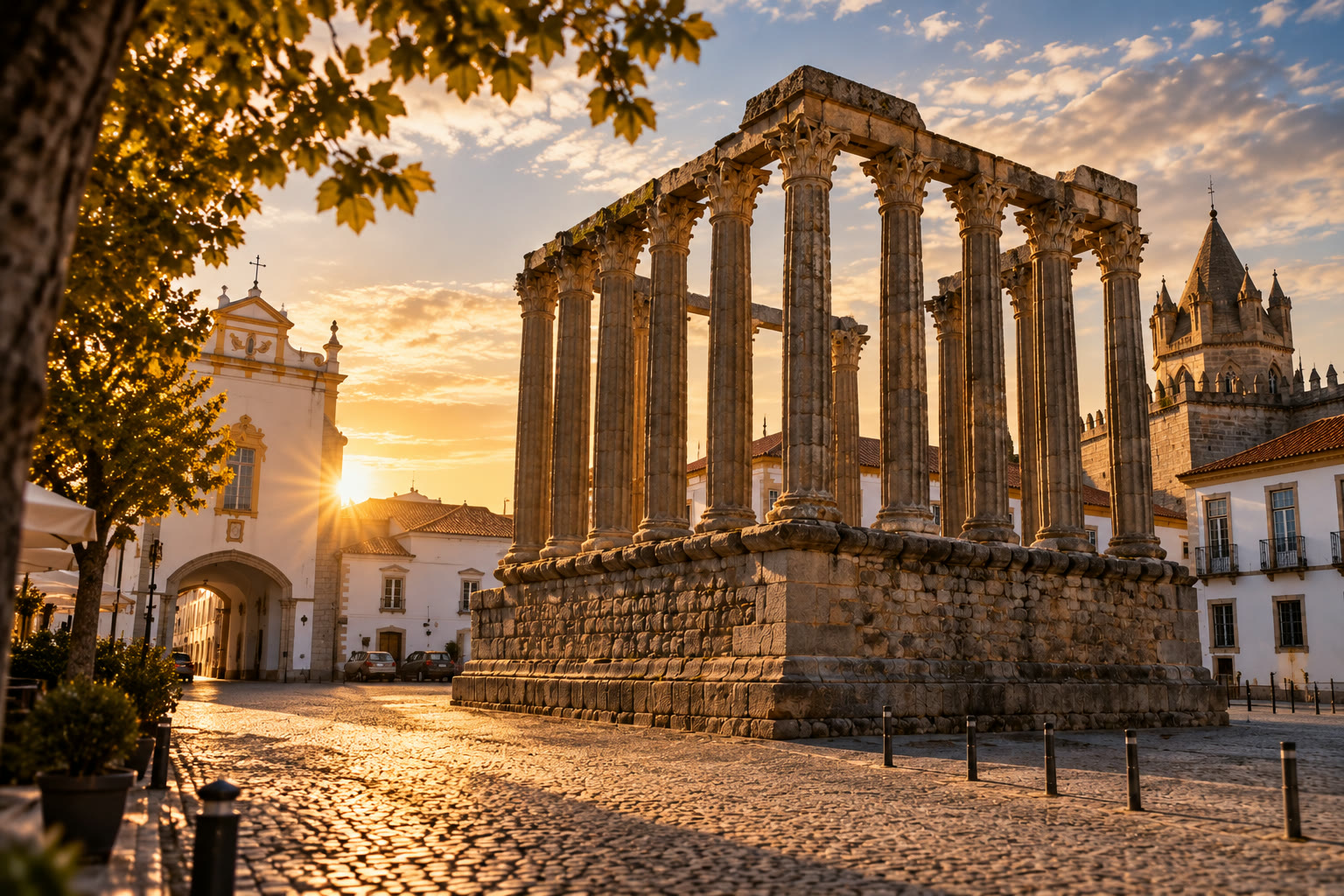
The Roman temple gives Évora’s long history a visible form. Its surviving columns stand in the old town, close to the medieval cathedral. Often called the Temple of Diana, it is worth approaching as a Roman monument rather than taking that familiar name as proof of its dedication. Look at the columns and their carved capitals before turning towards the buildings around them.
The nearby cathedral shifts the mood from an open-air ruin to enclosed medieval spaces. Include the cloister in your visit, giving its arches and stonework the same attention as the temple. Their proximity makes it possible to consider Roman and medieval Évora together, without a lengthy journey between them. Let the contrast set the pace.
For context, walking with a private historian connects these monuments with the wider city. The walk includes the temple and cathedral cloister, alongside lanes, squares and the old aqueduct. A guide can help distinguish what survives from different periods, so the centre becomes more than a sequence of façades. Afterwards, leave time to wander without commentary.
Stone, Roman and Megalithic Heritage
Roman Évora with a Private Historian
Évora
Read the layers of a walled city that has been lived in for two thousand years.
The Chapel of Bones and whitewashed lanes
Within the São Francisco church complex, the Chapel of Bones brings a change of mood. Human bones and skulls line its walls and pillars, forming a decoration intended as a reflection on mortality. The material is unmistakable, but so is the care of its arrangement. Rather than treating it as a curiosity, allow space for the religious purpose behind it. This is a place for a quiet visit, and its imagery will not appeal to everyone.
Outside, return to the whitewashed lanes without rushing towards another monument. Évora’s history is not confined to its interiors. It continues in the streets between churches, in the changing width of a lane and in the light falling across plaster. Walking gives these quieter details room to register. A walk with a private historian can connect the chapel with the Roman and medieval layers elsewhere in the centre. Whether exploring with a guide or independently, leave room for the ordinary streets: they give the monuments their setting, and the visit a gentler rhythm.
Squares, the aqueduct and a courtyard pause
Praça do Giraldo offers a useful point of orientation within the walls. Its arcades and stone fountain make it easy to recognise when the surrounding lanes begin to feel alike. Pause here to look across the square before continuing. After the enclosed spaces of churches and chapels, the open paving offers a different sense of the city. There is no need to turn every crossing into another stop on a checklist.
Make room, too, for the old aqueduct. Along Rua do Cano, houses occupy spaces beneath its arches, bringing a large piece of civic engineering into the scale of an everyday street. Look at the relationship between the stonework and the buildings below rather than trying to follow its entire course. Then let a courtyard coffee or lunch interrupt the walking. Bread, cheese or a plate of Alentejo cooking can belong to the visit as naturally as another doorway or façade. Keep the route flexible enough for a seated pause, with time afterwards to wander back through the centre on foot.
Planning an unhurried visit from Lisbon
The drive from Lisbon to Évora takes 1 hour 15 minutes to 1 hour 45 minutes. Allow room around that journey rather than filling the visit with successive stops. The historic centre is walkable, and its lanes and squares invite pauses between monuments.
Spring and autumn suit walking and long lunches. Winter days are often clear and mild. Let the season shape the pace: time among the temple’s columns, a quieter passage through the cathedral cloister, then a courtyard coffee before returning to the streets.
The historian-led walk through Évora lasts 3 hours. It brings the Roman temple, cathedral cloister, whitewashed lanes and old aqueduct into a connected account of the city. Leave space afterwards for lunch rather than treating the walk as a prelude to another full itinerary.
Keep the countryside distinct from the centre. The Almendres Cromlech and other megalithic monuments lie beyond Évora, among fields and cork oaks. They call for a separate excursion, not a detour between city sights.
A little unscheduled time leaves room to notice Évora: whitewashed walls, stone underfoot and the shade of a courtyard.