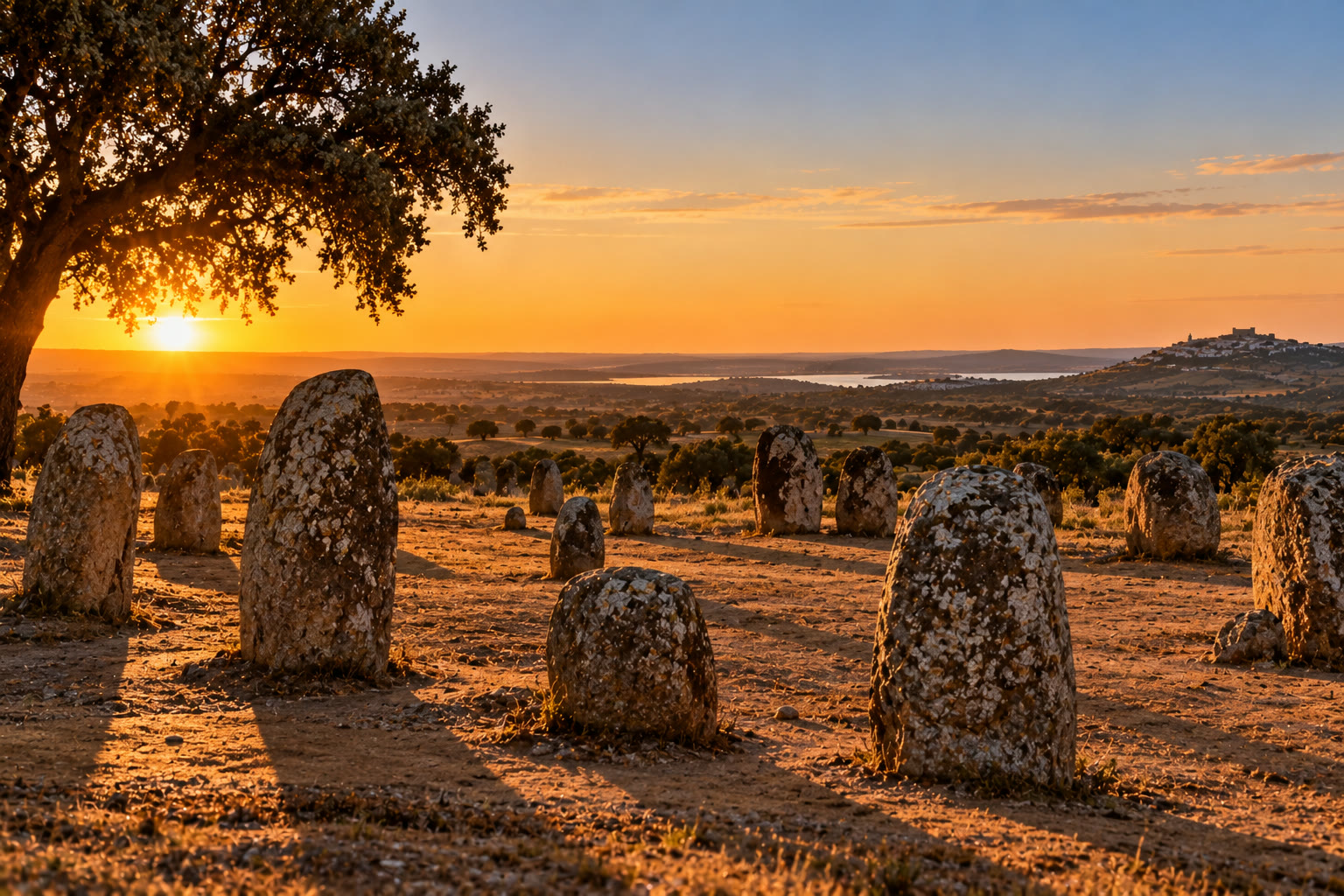
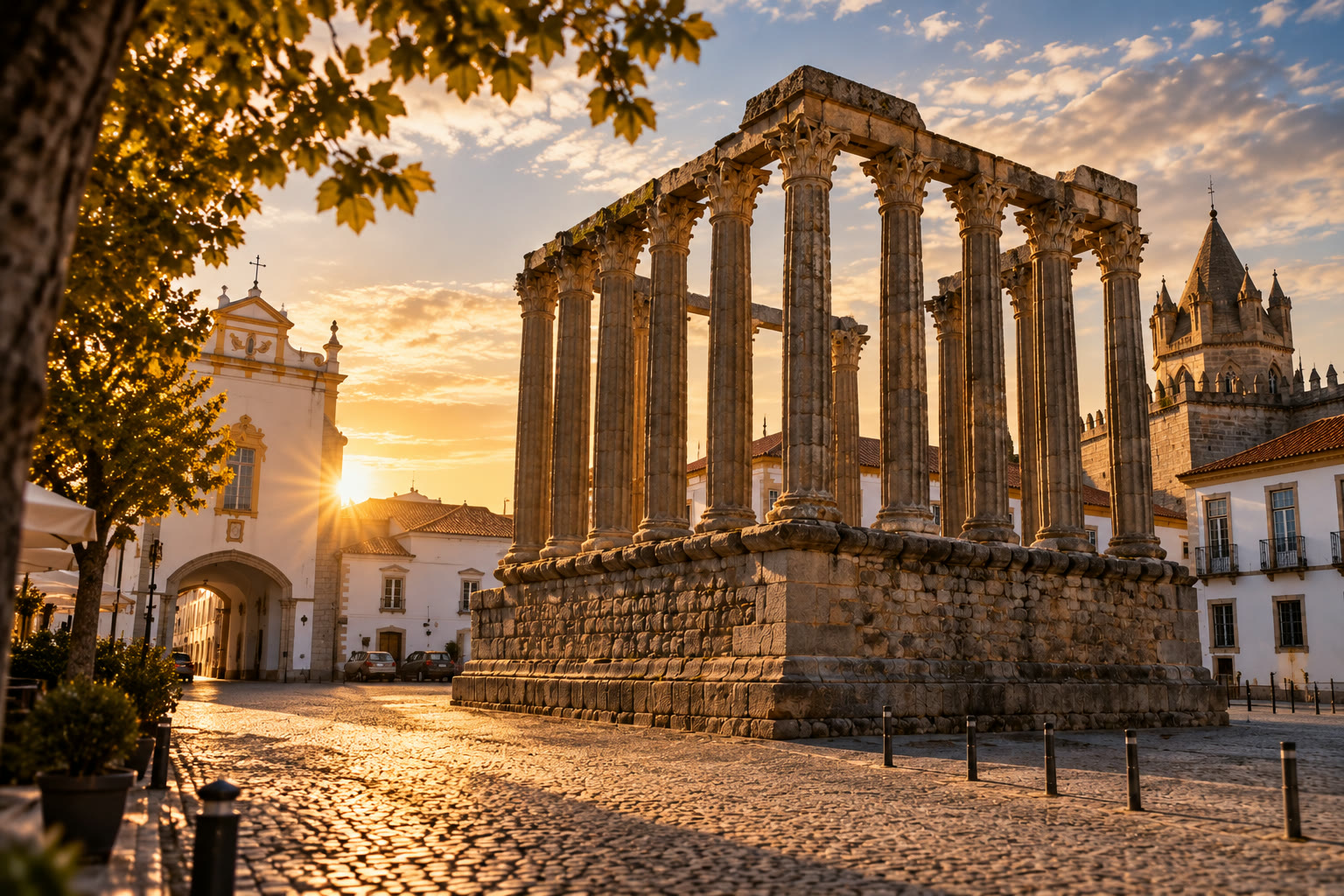
In Évora, Roman columns rise into open sky within a short walk of the cathedral’s heavy stone walls. The contrast is immediate: an ancient temple exposed to the weather, a medieval church built around enclosed space. Between them, the old town continues through lanes and squares.
These monuments offer a natural starting point for exploring the city. Look closely at the carved capitals, then step back to see how the remains sit among later buildings. Évora rewards this movement between detail and setting. There is no need to hurry away once you have seen the temple; the surrounding streets belong to the visit as much as the stone itself.
Finding your bearings in historic Évora
Évora’s walled historic centre is a UNESCO World Heritage Site, set in Alentejo Central. The Roman temple and nearby cathedral provide clear landmarks within its compact streets. Begin here to understand the city as a place of accumulated layers, rather than a collection of separate sights.
Walking lets you notice how those layers meet. Whitewashed houses line the lanes, which open into squares before drawing you back between buildings. Around the temple, the columns stand clear of their surroundings. Nearby, the cathedral presents a more solid outline. Moving between them makes the change in scale and architectural language easy to read.
Keep the opening part of your visit focused on this area. Take in the temple from the surrounding public space, orient yourself towards the cathedral, and leave room for a pause in the adjoining streets. Spring and autumn are well suited to walking and a long lunch. For a guided introduction, Roman Évora with a Private Historian connects the monuments with the lanes, squares and old aqueduct.
The Roman temple and its familiar name
Évora’s Roman temple survives as a raised stone platform and a group of columns crowned with Corinthian capitals. Their carved foliage brings a fine texture to the structure’s straight lines. Look upwards to follow the change from the column shafts to the elaborate capitals, then along the horizontal stonework that remains above them.
The familiar name Temple of Diana needs a little care. It is a later attribution, not proof that the temple was originally dedicated to the Roman goddess. Calling it the Roman temple of Évora leaves that distinction clear. The surviving architecture can be admired without treating a traditional name as an established account of its ancient purpose.
Step back after looking at the carving. The gaps between the columns matter as much to the present view as the stone: sky shows through where an enclosed building once stood. With the medieval cathedral nearby, the temple also invites comparison across periods. Resist imagining every missing element with certainty. What remains offers enough to study, from the weight of the platform to the leaves cut into the capitals.
Reading the cathedral’s medieval stone
Évora’s cathedral brings a different weight to the skyline from the neighbouring Roman temple. Its granite exterior feels solid and enclosed, with towers and deep openings replacing the temple’s exposed columns. Stand back before entering. The contrast is easy to read in the stone: a Roman structure open to the sky beside a medieval church shaped around an interior.
The cathedral’s architecture combines Romanesque and Gothic forms. Heavy walls and rounded forms belong to the Romanesque vocabulary; pointed arches introduce the Gothic. These labels are useful, but looking closely matters more than naming every feature. Notice the depth of the entrance, the carved figures around the portal and the way daylight catches the edges of the masonry.
This is part of the pleasure of exploring Alentejo Central on foot. In Évora, the change between ancient and medieval buildings needs no long journey. Leave room to look back towards the temple before moving inside. The nearby remains make the cathedral’s scale and enclosed character easier to appreciate.
A quieter pause in the cloister
The Gothic cloister deserves attention as a distinct part of the cathedral visit, rather than a passage on the way elsewhere. Here, pointed arches frame an enclosed courtyard. The building turns inward, away from the lanes and the Roman remains outside. Stone, shade and open sky give the space its rhythm.
Walk slowly along the covered galleries and look across the courtyard through the arches. Each opening changes the frame slightly. From the shaded side, the masonry stands against the light; looking along a gallery, the repeated arches draw the eye ahead. There is no need to make this a lesson in architectural terms. The relationship between the covered walk and the open centre is clear simply by moving through it.
Keep the cloister separate in your mind from the cathedral’s heavier exterior. Its Gothic forms offer a different way of experiencing the same material, with openings and shadows giving the granite a lighter rhythm. Pause here before returning to the whitewashed streets. The enclosed courtyard makes a gentle interval in a walk through historic Évora.
Continuing through the old town
From the temple and cathedral cloister, continue into the lanes of whitewashed houses. Évora’s walled historic centre is walkable, and the spaces between its monuments deserve attention too. Follow the streets into the squares, pausing to notice how carved stone gives way to plain walls and domestic doorways. The city’s history continues beyond its monumental buildings.
The Roman Évora with a Private Historian walk lasts 3 hours. It brings together the Roman temple, cathedral cloister, lanes, squares and old aqueduct. With a historian, these become connected layers of a city lived in for two thousand years, rather than separate stops. The route also takes in the Chapel of Bones and leads out through the city walls.
Leave room for a coffee or lunch in a courtyard along the way. Spring and autumn are ideal for walking and lingering over a meal. For a short visit, keep the temple and cloister as your anchors, then let the walk through the old town provide the wider context.
Stone, Roman and Megalithic Heritage
Roman Évora with a Private Historian
Évora
Read the layers of a walled city that has been lived in for two thousand years.
After the columns and arches, a quiet square offers a different way to remember Évora: white walls, stone underfoot and a pause at a table.