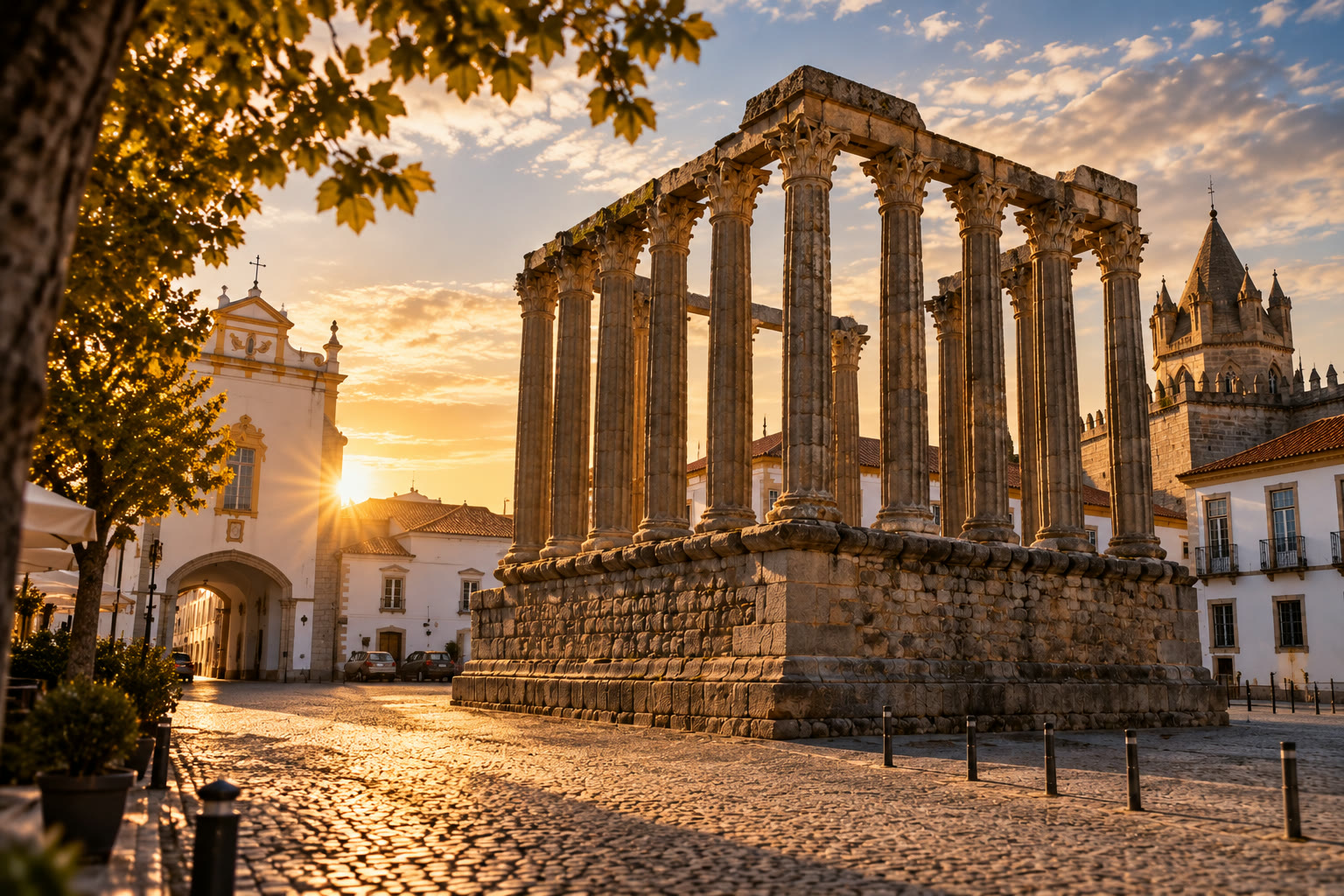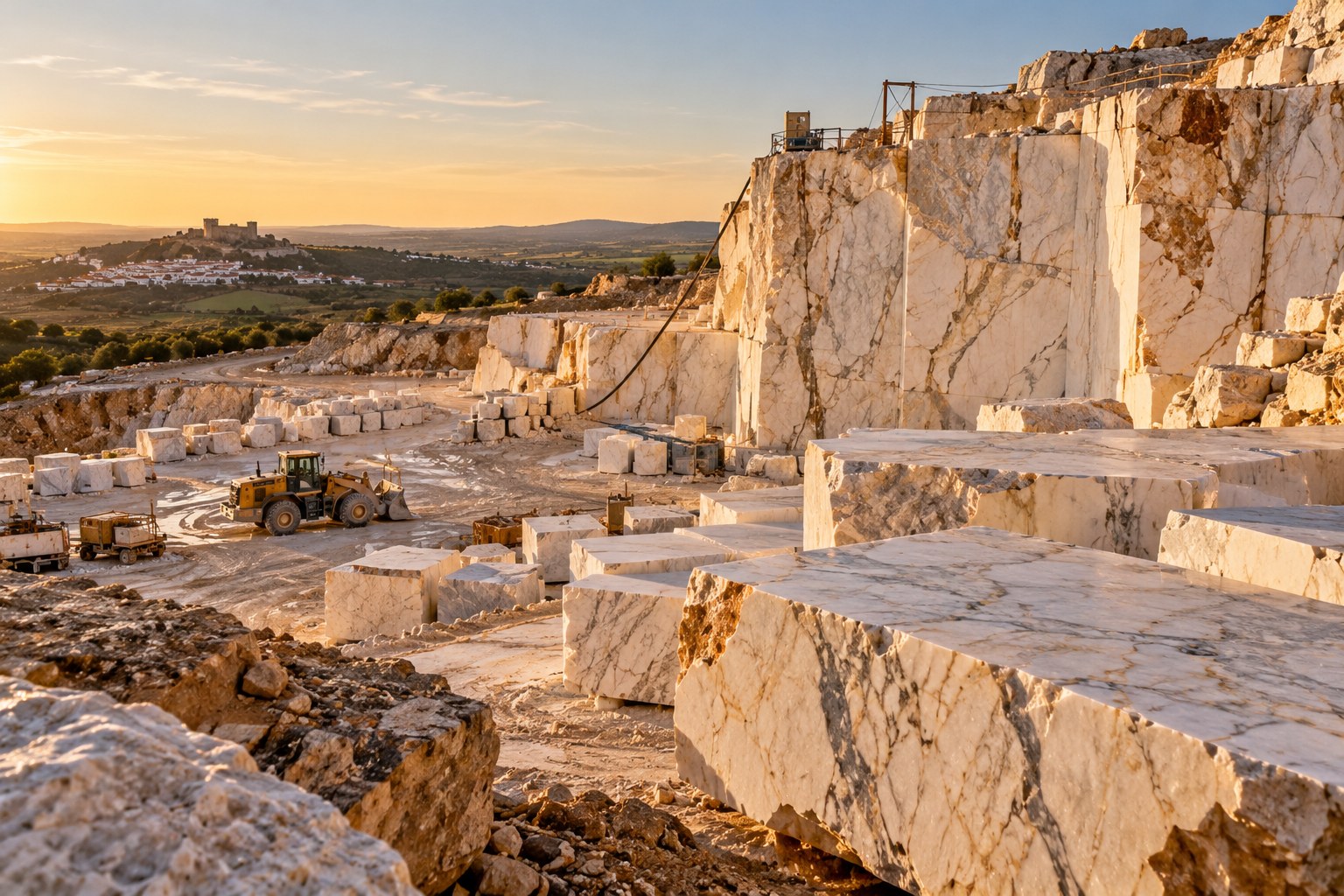
Beyond Évora, standing stones interrupt the familiar countryside of wheat fields and cork oaks. Some rise alone; others gather on a hillside or form the walls of a burial chamber. Their shapes invite a closer look, but their meanings are not always easy to recover.
These monuments belong to a landscape shaped by Neolithic farming communities, long before the Roman temple of Évora. To visit them is to consider both what survives and what has disappeared: stone remains, while much of the thought behind it does not. Knowing the difference between a dolmen, a menhir and a cromlech gives that encounter a useful starting point.
A prehistoric landscape beyond Évora
Alentejo Central offers a natural beginning for understanding this prehistoric countryside. Outside Évora’s walls, chambered tombs and upright stones stand among fields and cork forests. At Almendres, a Neolithic group of standing stones occupies a hillside among cork oaks. The monuments belong to the land around the city, rather than to its streets and squares.
Their builders lived in a farming world. Cultivation and the keeping of animals shaped daily life, alongside the work of raising monuments and caring for the dead. Moving and setting large stones required shared effort. The structures that remain give material evidence of that work, even where the beliefs behind it are uncertain.
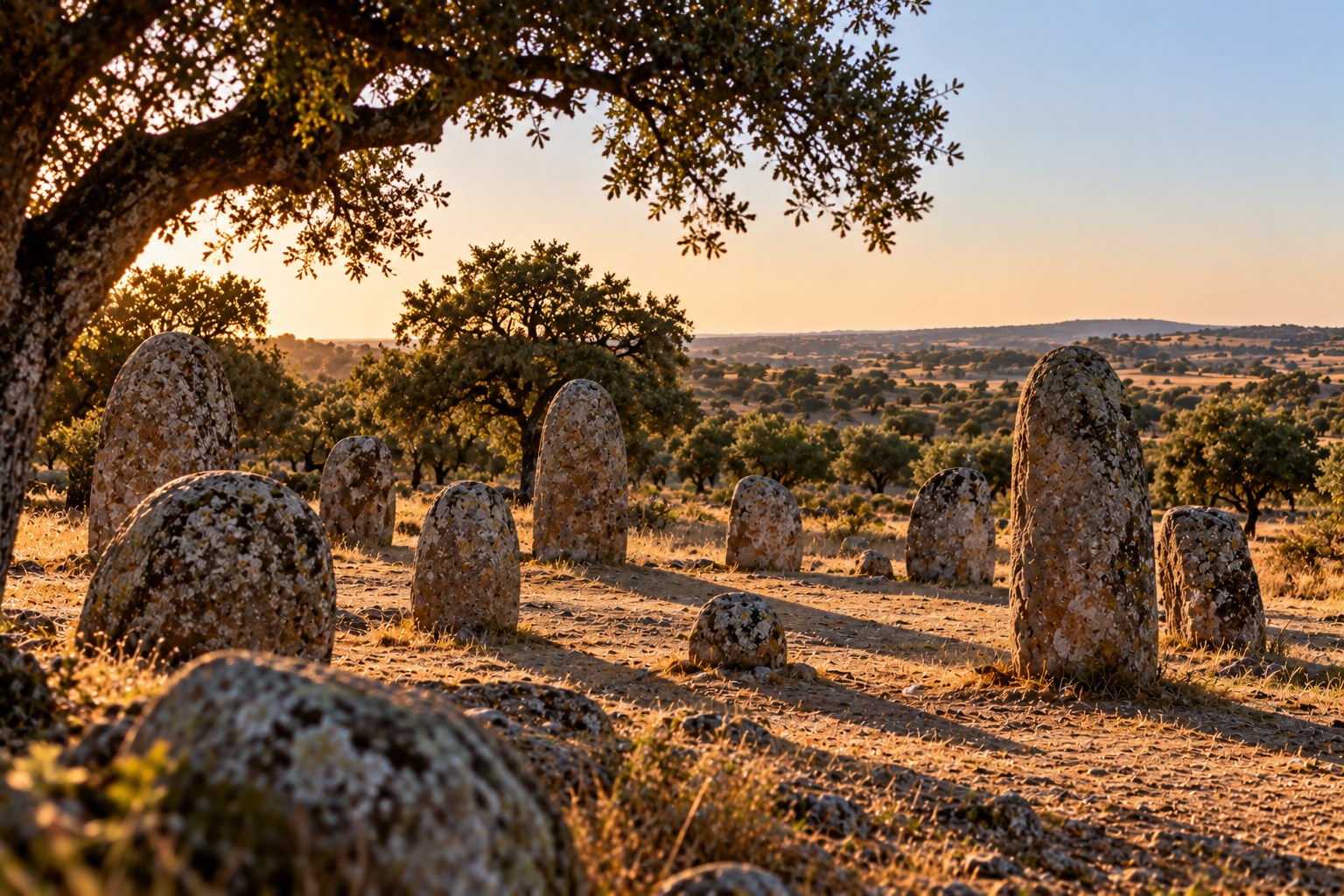
The present landscape is not an unchanged picture of the Neolithic. Today’s wheat fields and managed cork woodland frame monuments from a much earlier world. A guided exploration of the dolmens and menhirs outside Évora can help separate those layers. Look at the form of each monument before reaching for an explanation: an enclosed chamber and an upright stone pose different questions.
Dolmens, menhirs and cromlechs: reading the forms
A dolmen is a stone burial chamber, typically formed from upright slabs supporting a capstone. In Portugal, the term anta is commonly used for these monuments. Many were originally covered by an earthen mound, so the exposed stones seen today do not necessarily show the structure as its builders intended it to appear. Some chambers were approached through a passage.
A menhir is an upright standing stone. The word describes its form, not a settled explanation of its purpose. A stone standing alone should not automatically be read as a grave marker or an astronomical instrument. Its setting and archaeological context matter, and interpretations may remain open.
A cromlech is a group of standing stones arranged together, often in a circular or oval layout. Almendres is described as a Neolithic stone circle. Here, the relationship between stones becomes part of what you observe, rather than the shape of an individual stone alone. These terms provide a vocabulary for looking. They distinguish a burial chamber from a standing stone or a stone group, without claiming to explain every ancient intention.
Almendres: standing stones among cork oaks
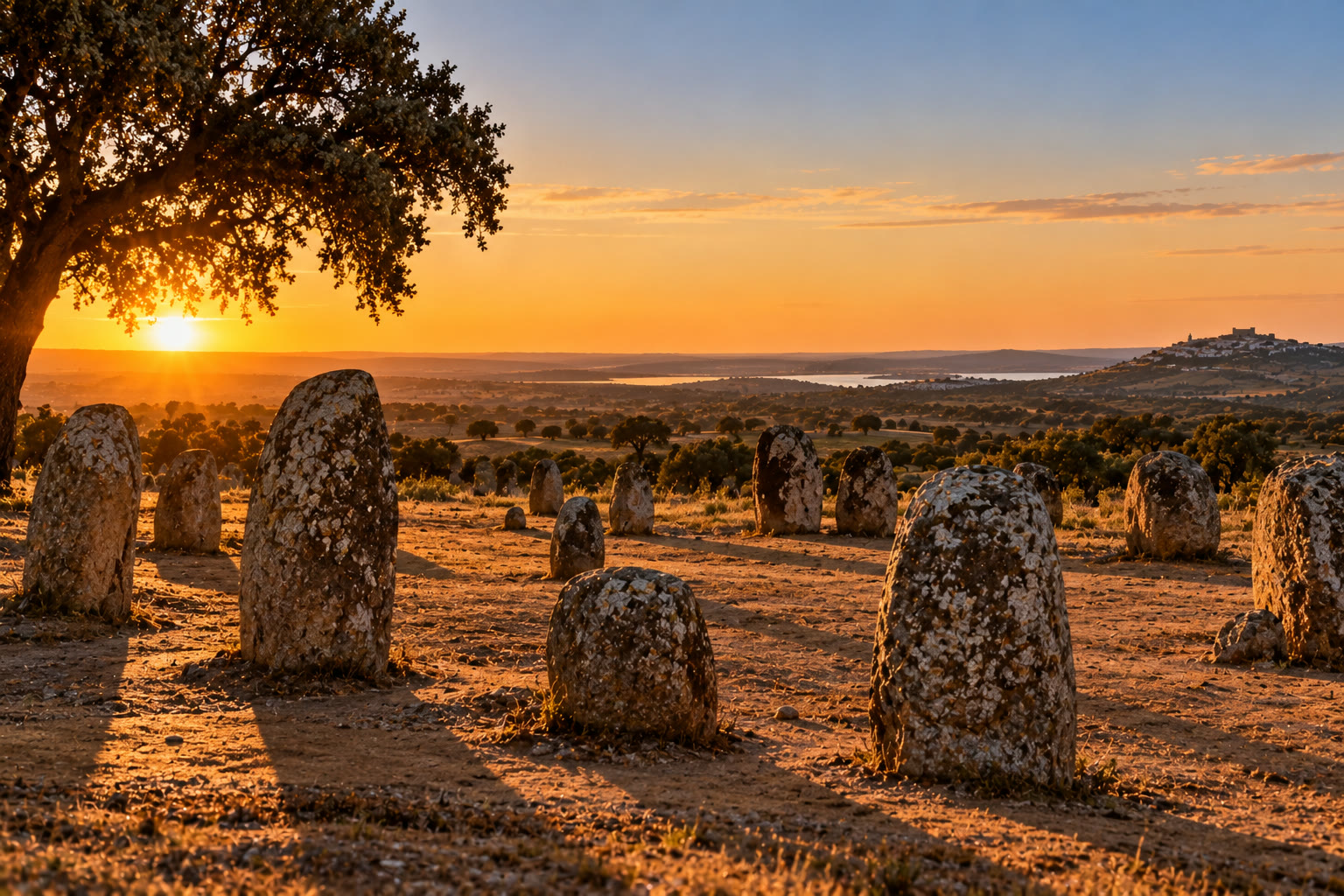
Near Évora, the Almendres Cromlech occupies a hillside among cork oaks. Its standing stones belong to the Neolithic farming world, long before the Roman city took shape. Here, stone and landscape share your attention: the rounded forms of the megaliths, the trees beyond them, the ground falling away across the slope.
Early light brings out the contours of the stones. A quiet walk allows time to notice their arrangement rather than treating the group as a backdrop. The Almendres visit also includes a nearby menhir, giving a useful contrast between a gathering of stones and an upright monument standing apart.
A guide can explain the arrangement and discuss interpretations of its relationship to the sky and the seasons. Those readings should remain distinct from certainty about what people believed or did here. The stones survive; a complete account of their meaning does not. Stay on marked paths through this fragile site, and let careful observation take precedence over a story that claims to explain every feature.
Stone, Roman and Megalithic Heritage
Sunrise at the Almendres Cromlech
Near Évora
Stand among standing stones that are older than Stonehenge.
What the monuments tell us, and what remains uncertain
Burial offers a firm starting point for understanding dolmens. These stone chambers housed the dead, making them places where prehistoric communities gave material form to their treatment of death. Their surviving structure tells us more securely about construction and burial than about the words spoken or beliefs held around them.
Raising large stones required shared labour and planning. The monuments therefore speak of cooperation as well as technical knowledge. Yet communal effort does not reveal precisely who directed the work, how decisions were made, or whether everyone understood a monument in the same way. A chamber or standing stone is evidence, not a complete record of the society that built it.
Ritual, the sky and seasonal change belong in the discussion, but with care. Suggested alignments may help archaeologists explore how farming communities understood their surroundings. They do not establish a proven purpose for every stone. Ask which interpretations rest on physical evidence and which remain proposals. That distinction leaves room for curiosity without turning uncertainty into an elaborate prehistoric story.
An unhurried visit through the countryside
Allow a half day for a guided journey through the Évora countryside, travelling by private vehicle between monuments. Wheat fields and cork groves form the setting for standing stones and chambered tombs. Keep the pace loose enough to look at their shapes and placement, rather than treating each stop as something to complete.
A dolmens and menhirs visit brings several sites together with a guide who can explain burial practices and discuss possible connections to the sky and seasons. Ask where the evidence ends and interpretation begins. The gaps in our knowledge deserve space alongside what archaeology has established.
Visit in a small group and take care around the surrounding fields. At Almendres, stay on marked paths; elsewhere, avoid trampling crops or crossing fields to shorten the approach. Spring and autumn suit walking. A countryside picnic provides a quiet pause after the monuments, without adding another destination to the day.
Practical tip: leave room for the landscape between stops. The fields and groves are part of the visit, not simply the distance to cover.
Stone, Roman and Megalithic Heritage
Dolmens and Menhirs of the Countryside
Évora countryside
Find prehistoric monuments hidden in fields and groves.
Leave with time to remember the stones against the trees, and with some questions still open.