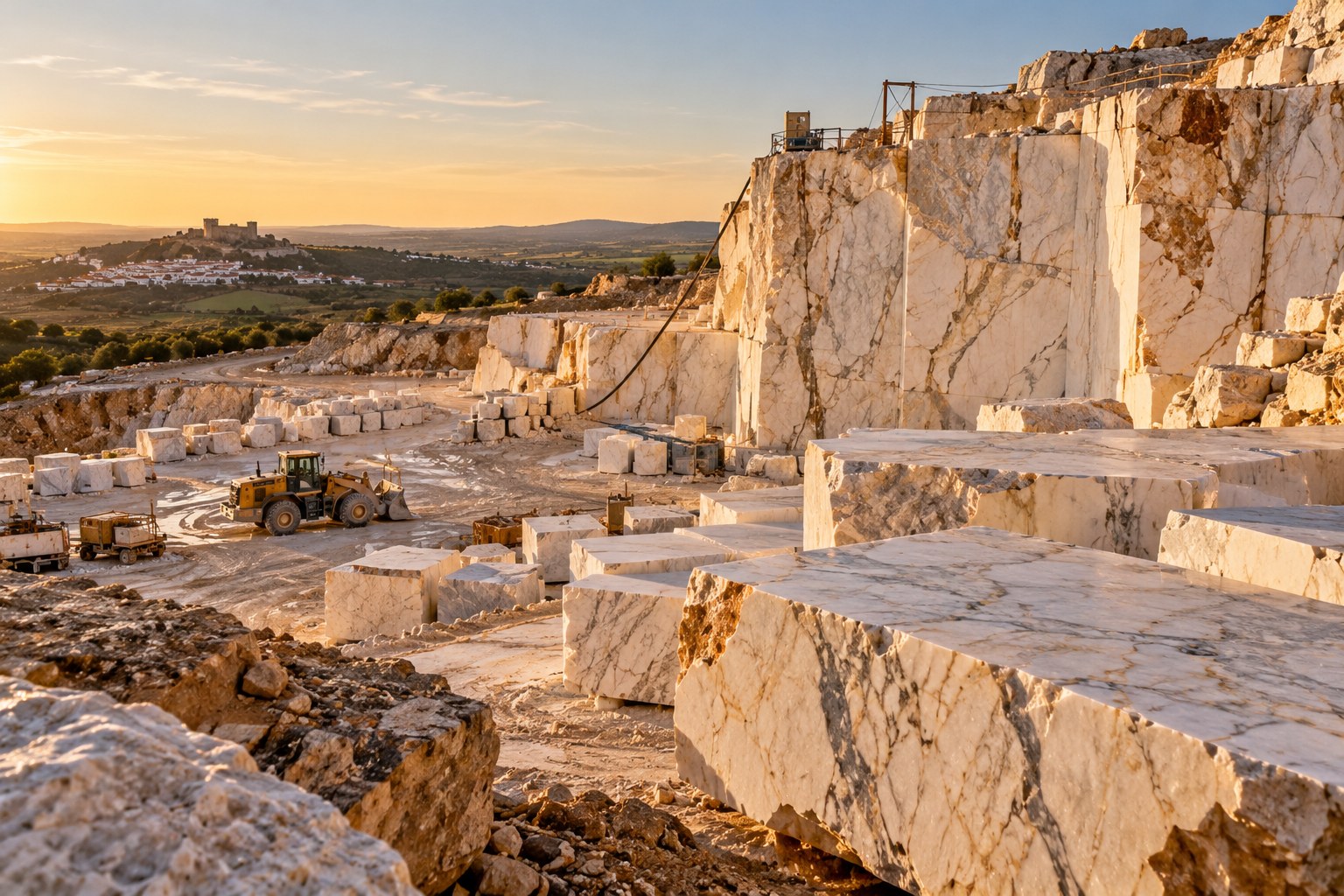
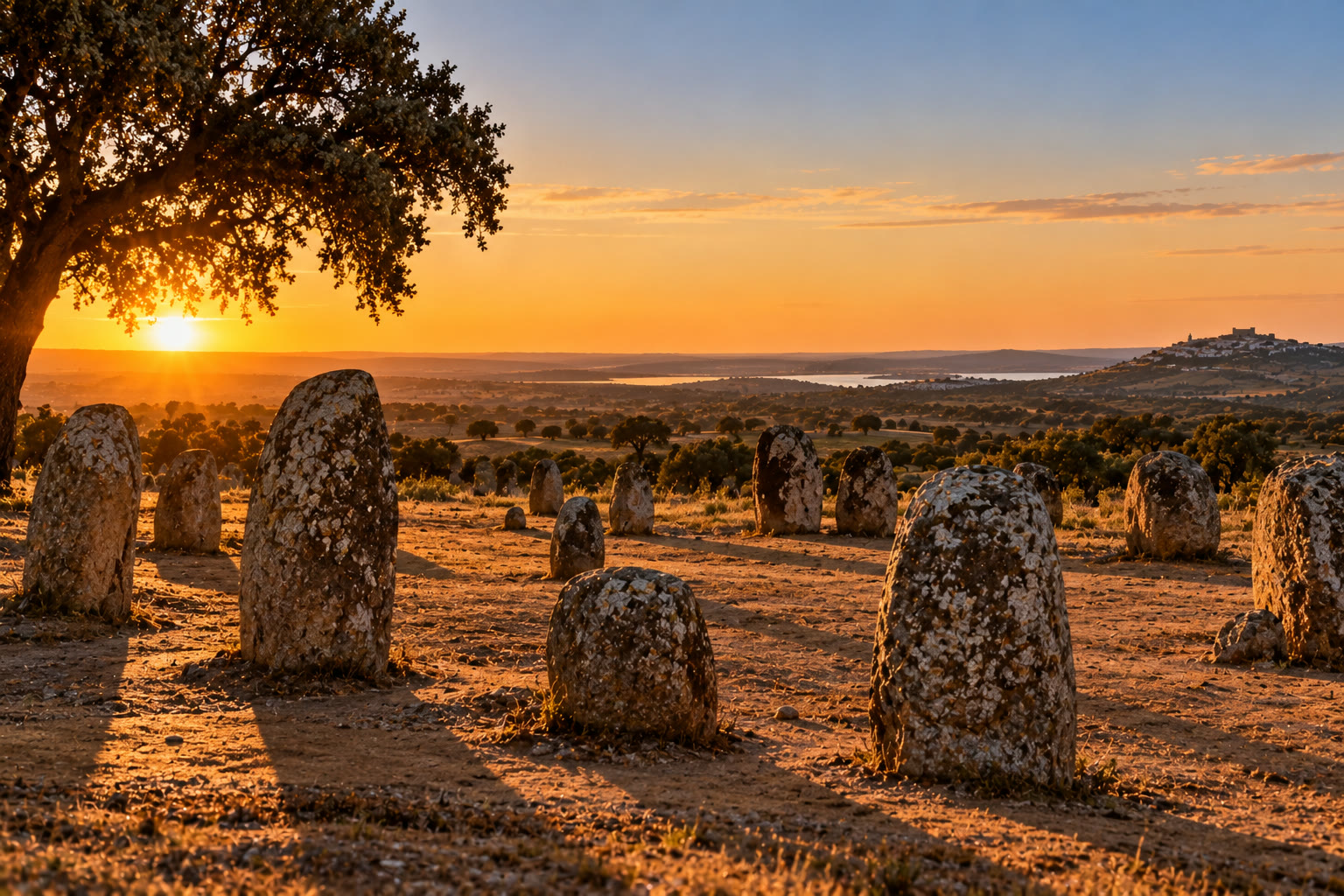
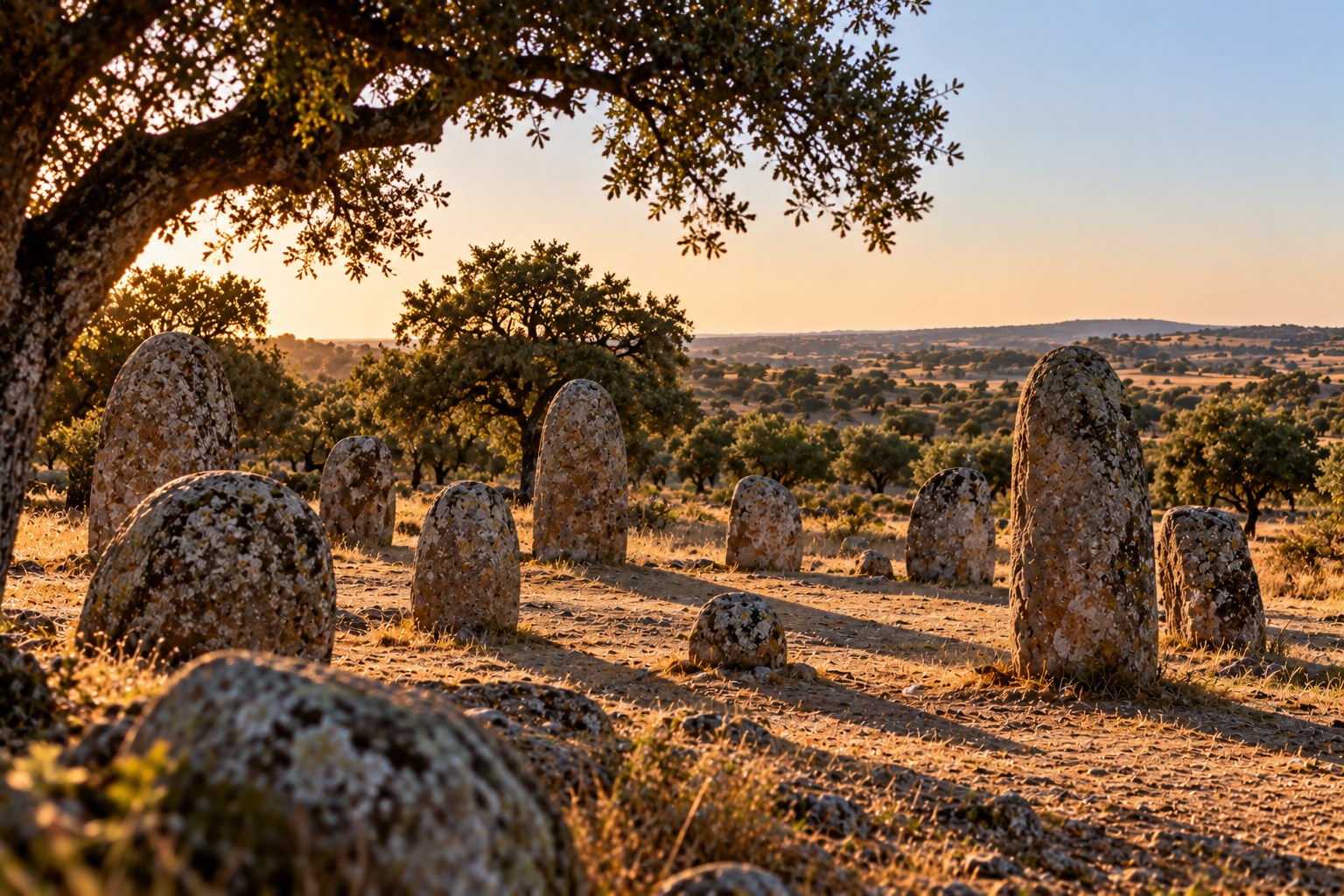
Near Évora, the Almendres stones stand on a hillside among cork oaks. In the early light, their rounded surfaces emerge slowly from shadow. The landscape invites a quiet approach: follow the marked paths, pause, and let your eye move between the stones and the trees.
This is a Neolithic monument, raised by farming communities whose lives remain partly beyond our understanding. A respectful visit makes room for that uncertainty. There is much to learn here, but no need to turn every alignment into an explanation. Begin with what survives: standing stones, their arrangement across the ground, and the questions that archaeologists continue to ask of them.
What is the Almendres Cromlech?
A cromlech is an arrangement of standing stones. At Almendres, near Évora in Alentejo Central, that simple definition takes shape across a hillside among cork oaks. The monument belongs to the Neolithic, the period associated with the establishment of farming communities. Its stones are not an incidental scattering of rock, but the surviving elements of a place deliberately formed by people.
The term “stone circle” offers a useful introduction, though it should not lead you to expect a neat ring of identical uprights. Look instead at the relationships between individual stones: their differing outlines, the spaces separating them, and the arrangement they create together. These are things to observe before reaching for an interpretation.
The setting matters to the experience, too. Cork oaks place the monument within the countryside around Évora, beyond the walled city and its familiar Roman remains. Yet the landscape you see today should not be treated as an exact picture of the Neolithic world. The stones connect those distant lives with ours without revealing every detail of them.
What the stones tell us, and what remains uncertain
Almendres was raised by farming communities thousands of years ago and is older than Stonehenge. That comparison gives a sense of its antiquity, rather than a complete explanation of its history. The monument belongs to the prehistoric countryside around Évora, where standing stones and chambered tombs survive in fields and groves.
Archaeological understanding begins with evidence: the stones themselves, their arrangement and their context. Explaining exactly how people used the site requires greater caution. Alignments can be studied, but an interpretation of their meaning is not the same as certainty about the intentions of those who placed them. Ritual, the sky and the seasons belong to the discussion, not to a single settled account.
The guided Almendres visit makes space for both what archaeologists understand and what remains unresolved. Ask which observations support an explanation, and where interpretation begins. This distinction does not diminish the encounter. It lets you look closely without asking the stones to tell a story more precise than the evidence allows. Their age is tangible; much of their human meaning remains open.
Visiting in the early light
At dawn, light moves across the Almendres stones and the hillside among the cork oaks. The changing light gives shape to their rounded surfaces. There is no need to hurry between them. Pause on the marked path and let your gaze move from the stone in front of you to the arrangement beyond.
The guided dawn visit allows time to look and to ask questions. A guide explains what archaeologists understand about the monument, while leaving room for what remains uncertain. Questions about alignment and use deserve that distinction: an interpretation need not become a certainty to hold your attention.
The experience lasts 2 hours and includes a nearby menhir and a countryside cafe. Together, these make an unhurried passage from the stone circle back into the everyday life of the countryside.
Spring and autumn are suitable seasons for walking in Alentejo Central. Keep the rest of the morning lightly planned, so that looking closely does not become something squeezed between other stops.
Stone, Roman and Megalithic Heritage
Sunrise at the Almendres Cromlech
Near Évora
Stand among standing stones that are older than Stonehenge.
How to explore without disturbing the site
Almendres is a fragile ancient site, not simply a setting for photographs. A respectful visit begins with a quiet approach and a small group. Give the stones your attention without making them props: look rather than climb, and leave their surfaces untouched.
Stay on marked paths, including when choosing where to pause or take a photograph. A different angle is not a reason to step beyond them. Let the route shape your view of the monument rather than trying to reach every stone. There is much to notice from a still position: the spacing of the stones, their outlines and the cork oaks around them.
Carry that same care into visits to other megalithic monuments in the Évora countryside. Standing stones and chambered tombs rise among fields and groves. Their surroundings deserve attention too; avoid trampling the fields as you approach or move away.
Practical tip: Keep your group together on the marked paths and save longer conversations for the countryside cafe afterwards. This leaves more room for quiet observation at the monument.
Stone, Roman and Megalithic Heritage
Dolmens and Menhirs of the Countryside
Évora countryside
Find prehistoric monuments hidden in fields and groves.
Continue through Évora’s layers of history
After the standing stones, Évora offers a different way to read the past. Its walled historic centre is a UNESCO World Heritage Site, with a Roman temple rising above the old town. The shift from cork oaks and open ground to whitewashed lanes is part of the pleasure. Here, history takes the shape of columns, courtyards and walls.
Explore on foot, leaving room to pause rather than turning the city into a sequence of monuments. The Roman temple and medieval cathedral bring different periods into view; farther through the streets, the old aqueduct adds another layer. A walk with a historian can help distinguish what survives from the stories attached to it, continuing the thoughtful approach begun at Almendres.
For context, Roman Évora with a Private Historian connects the temple, cathedral cloister, lanes and squares. Spring and autumn suit walking here as well as in the surrounding countryside. Leave space for a courtyard coffee or an unhurried lunch, allowing the morning’s stones to settle in the mind.

Stone, Roman and Megalithic Heritage
Roman Évora with a Private Historian
Évora
Read the layers of a walled city that has been lived in for two thousand years.
From the hillside to the city walls, carry the same habit of attention: walk quietly, look closely and leave things as you find them.